
I recently worked with one of my long-time customers - a catering company I’ve been working with for years. €500M+ revenue, 5.000 employees across multiple sites, sophisticated operations managing workplace canteens, cafeterias, and event catering.
Their CTO had built a working demand forecasting prototype on a Raspberry Pi 5. It worked. They wanted to productionize it - run it at scale in the cloud instead of under someone’s desk. The hyperscaler solution architect and hyperscaler partner sales showed up with a proposal: data lake architecture, Lake Formation for governance, Glue for ETL, EMR for processing, comprehensive data catalog, multi-phase implementation. They had 30GB of total data in Redshift.
The right solution? Deploy SageMaker Unified Studio, point it to Redshift, and keep it simple. Five days from kickoff to forecasting models running in production.
This isn’t a story about incompetent salespeople or a bad hyperscaler. This is a story about a systemic industry blind spot.
The Pattern Nobody Talks About #
Mid-market enterprises - roughly €500M to €5B revenue, 1.000 to 10.000 employees - have a specific IT profile that the entire tech industry misunderstands.
On paper, this looks like an enterprise IT organization. In practice, it isn’t.
They might have 100 people in IT. Vendors see this number and think “enterprise IT organization.” But look closer:
- 40 Windows admins and desktop support
- 20 helpdesk managing tickets
- 15 network operations keeping infrastructure running
- 10 people managing SAP/ERP systems
- 5 security and compliance staff
- 20-30 people doing cloud infrastructure, data platforms, ML projects, and application development
These aren’t software companies. They’re manufacturing firms, catering operations, logistics providers, service companies. They might have a couple hundred embedded software engineers writing code for their machines or products - and that team is world-class at what they do. But the team handling cloud infrastructure, data platforms, ML projects, and application development (including web interfaces for their products)? Right-sized at 20-30 people.
And here’s the key: their products are B2B or internal. They might have 10.000 total users, not millions. The requirements are completely different from running a B2C webshop or consumer application. “Infinite scale” is never in scope. They don’t need architecture designed for viral growth or massive traffic spikes.
Vendors see €500M revenue and 100+ IT headcount and pull out the enterprise playbook — one designed for organizations with hundreds of engineers, silos, and coordination failure.
The fatal mistake: trying to “scale down” enterprise solutions for mid-market execution.
You Can’t Scale Down Complexity to Get Simplicity #
Here’s what vendors fundamentally misunderstand: you can’t take a solution designed for Netflix’s 1.000 microservices and 50 siloed teams and just “simplify it” for a mid-market company.
Enterprise architecture isn’t about traffic scale. It’s about organizational distrust at scale. Mid-market companies usually don’t have that problem.
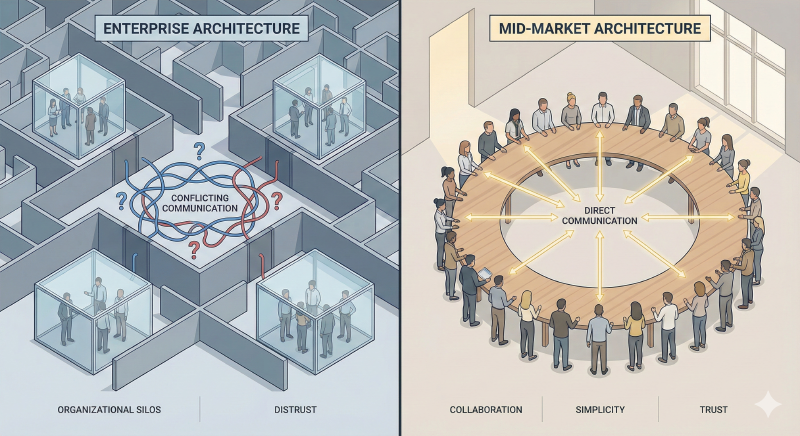
A company with 30GB or even 100TB of data doesn’t need Lake Formation, Glue, EMR, and governance layers. They need a data warehouse (Redshift, Snowflake, BigQuery, ClickHouse). The “enterprise data platform” adds operational complexity, requires more people to maintain, and solves problems they don’t have.
A team of 25 developers doesn’t need “simplified service mesh.” They need services that can talk to each other directly because everyone sits in the same office and actually communicates.
The industry keeps trying to sell:
- Orchestration layers for teams that don’t have coordination problems
- Service isolation for people who share the same codebase
- Governance frameworks for organizations where everyone knows what’s happening
- Multi-phase implementations for companies that need solutions in weeks, not quarters
The Root Cause: Engagement-Driven Content #
Why does this happen? Look at what dominates industry content:
“How Netflix built their data platform across 50 teams”
“Scaling microservices to 1.000 services at Uber”
“Data mesh architecture for siloed organizations”
This content generates engagement. It gets clicks, conference slots, and social media shares. It’s genuinely valuable - for companies facing similar scale and organizational complexity as Netflix or Uber.
The problem: hyperscalers build tools based on these patterns. Solution architects learn from these examples. Blogs and documentation showcase these massive-scale solutions. The entire industry optimizes for problems that 99% of companies will never have.
And for mid-market enterprises specifically: these are mature, stable companies with predictable growth. They’re not in hyper-growth mode. They won’t suddenly need to coordinate 50 siloed teams or scale to millions of users. The coordination and scaling problems that these enterprise solutions solve? They’re never coming.
What doesn’t generate engagement?
- “We used Redshift and dbt for our 50GB of data and it works fine”
- “Our 20 developers share a monorepo and deploy together”
- “We kept it simple with YAGNI and KISS principles”
Boring. Unsexy. No conference talk in that. But it’s what actually helps most companies.
The Pattern in Practice #
The same misunderstanding appears everywhere:
AI Orchestration platforms designed for teams that don’t trust each other’s APIs. Your webhook comes in with data - but the “enterprise solution” makes you write it to a presigned URL, wait for detection, trigger orchestration, run your job, write results to another presigned URL, detect completion, then call back. When your 25-person team could just trigger a Step Function directly with the webhook data.
Bedrock AgentCore Gateway for managing MCP servers across agents. Makes sense when you have multiple teams building different agents that need to discover shared tools. For a team of 20 developers sharing the same codebase? Your tools are just Python functions in a shared library. You don’t need service boundaries and discovery layers for people who sit in the same room.
These aren’t bad solutions. They’re solving real problems - for organizations with siloed teams, political boundaries, and coordination complexity. Mid-market companies with 20-30 engineers working together don’t have these problems.
Wrap #
Mid-market enterprises (€500M-5B revenue) have 20-30 people doing cloud, data, and ML work. They’re mature, stable, B2B or internal. Teams actually talk to each other.
They don’t need:
- Data lakes for 30GB (modern DWH handles 100TB+)
- AI orchestration theater for teams that share code
- Service mesh for people in the same office
- Scaled-down Netflix patterns
They need: purpose-built simple solutions, not enterprise complexity.
The industry optimizes for Netflix-scale content because it generates engagement. For everyone else, it’s a trap.
Someone needs to write boring content that actually helps. This is me trying.
Until vendors design for this reality, architects in the mid-market will keep winning by ignoring the playbooks.
Building for mid-market enterprises? The boring, right-sized solutions nobody writes about are what most companies actually need.
— The Pragmatical Architect